

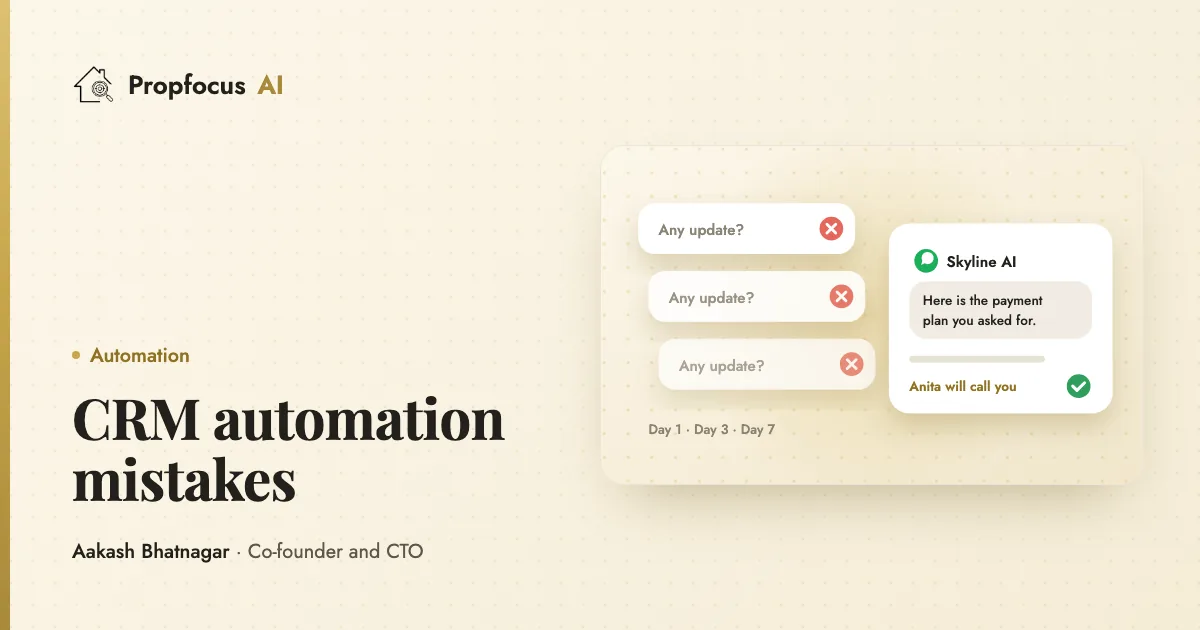
Automation that sends every lead the same messages on the same schedule hurts conversion. It annoys the buyers who are not ready and under-serves the ones who are. Good automation does the opposite: it times each message by what the buyer did, says it is AI, stops after two unanswered messages, and hands the buyer to a person the moment they reply.
Many residential developers in India already run some form of real estate lead automation: an auto-reply on the enquiry form, a drip sequence in the CRM, a reminder for the presales executive. The question is not whether to automate. It is whether the automation moves leads towards a site visit or just moves messages.
Why does sending every lead the same sequence hurt conversion?
The classic CRM workflow is time-based: message on day one, day three, day seven, then a call task. Every lead gets it, whatever the buyer has done since enquiring.
That treats a buyer who opened the microsite three times last night the same as a buyer who never opened anything. The engaged buyer waits until day three for the next step. The disengaged buyer gets a message they did not want.
The difference between those two buyers is large. Across 10 projects in Bengaluru and Hyderabad, buyers who engaged with their microsite walked in for a site visit 16.6% of the time. Buyers with no signal walked in 5.8% of the time. Engaged buyers were 2.9x more likely to visit, and 37% of the buyers produced 62% of the site visits.
The fix: time messages by engagement, not by the calendar. When a buyer opens the page, comes back, or asks about price, that is the moment for the next message or the call. Localising the message by city and project helps, but a well-localised blast is still a blast.
Why does a bot that pretends to be a person backfire?
Many auto-responders are written to sound like a named executive: "Hi, this is Rahul from the sales team." The buyer replies with a real question about the floor plan or possession date, gets a canned answer, and realises nobody is there. Trust drops at the exact point the buyer showed interest.
The opposite also fails: a generic template that answers nothing about the project the buyer asked for.
The fix: an assistant that says it is AI and knows the project. A good one introduces itself as the project's AI assistant, for example "Skyline AI", answers from the microsite the buyer asked for, and is clear that a person from the team will follow up. Buyers are comfortable with an AI assistant that is honest and useful. They are not comfortable being misled.
How many unanswered messages are too many?
Drip sequences often run to many touches. If the buyer has not answered the first two, the rest do not revive interest. They train the buyer to mute the chat, and on WhatsApp they invite blocks and reports; Meta says it may limit or offboard a business (opens in a new tab) whose account receives excessive negative feedback from users.
The fix: two unanswered messages, then stop. Leave the lead alone until the buyer shows a sign of interest, such as opening the page again. Message only buyers who gave consent on the enquiry form, and respect every opt-out straight away. Restraint is what keeps WhatsApp working as a channel for the buyers who do want to hear from you. Our WhatsApp follow-up guide covers the cadence in detail.
What goes wrong when automation never hands the buyer to a human?
Some teams automate so much that a buyer who replies "Can I visit on Saturday?" gets another template instead of a call. The automation was built to send, not to listen.
Homes are a high-ticket, family decision. Buyers want a person before they commit to a visit, and the presales executive is still the one who books and confirms it.
The fix: hand over the moment the buyer replies or engages. The rep should get the buyer's name, the project, what they asked and what they looked at, so the first call starts from context, not from "Are you still interested?" Real estate sales automation should make the human conversation happen sooner, not replace it.
Why is treating the CRM as the thing that works the lead a mistake?
A CRM is a system of record. It stores the lead, the source, the owner and the call notes. It does not call anyone, answer anyone or notice that a buyer came back to the page at 10pm.
Teams buy a CRM, add workflows, and assume the leads are being worked. In practice the record shows "RNR" (ringing, no response) after a few missed calls and the lead sits there. Across the same 10 projects, 2,706 of the buyers reached were RNR leads. 586 of them engaged with their page when they were worked on WhatsApp, and 63 walked in for a site visit. Those leads were already in the CRM. Nobody was working them. Clean data matters too, so deduplicate and fill the key fields, but a perfectly clean record that nobody works is still a lost lead.
The fix: keep the CRM as the record and put something inside it that works every lead. A real estate CRM with WhatsApp integration is only useful if the WhatsApp side follows up, reads the replies and writes back to the record. See the RNR leads guide for how written-off leads come back.
Why does measuring sends and opens mislead you?
Automation dashboards report messages sent, delivered and read. Those numbers rise with every extra touch, so the worst sequences often look the best.
The number that matters for presales is lead to site visit, and with it, cost per site visit. A sequence that sends half as many messages and produces more visits is the better sequence.
The fix: measure each automation step by the site visits it leads to. Compare engaged buyers with the rest. Across three developers' portfolios, engaged buyers walked in 2.9x, 4.2x and 2.4x more often than buyers who did not engage. If your automation cannot show that split, it cannot tell you which steps are working. The lead to site visit conversion guide sets out how to measure it.
How Propfocus AI avoids these
Propfocus AI is the AI presales platform for real estate developers. Its AI agents work every lead a developer has paid for, on WhatsApp and inside the developer's CRM, until it becomes a site visit.
- Timing by engagement. Intent Alerts sees which buyers are engaging with the microsite for the project they asked about, tells the lead owner (the rep the lead is assigned to) who to call now on WhatsApp, and gives each rep a ranked call list every morning.
- Disclosed AI. The agents introduce themselves as the project's AI assistant and say they are AI.
- Restraint. A stop rule agreed with the developer before go-live, for example two unanswered messages, then stop. Messages go only to buyers who gave consent at enquiry, and opt-outs are respected.
- Human handover. The RNR AI Agent and the After-Hours AI Agent hand a buyer to the rep as soon as they reply. Leads that arrive at night are answered then and handed over in the morning; the after-hours leads guide explains why that window matters.
- Inside your CRM. It works inside your existing CRM, including Salesforce. Nothing changes for the team.
Propfocus AI is an official WhatsApp partner, with direct access to Meta's WhatsApp Business Platform. It is ISO 27001:2022 certified, hosted on AWS in India and aligned with the DPDP Act (India's Digital Personal Data Protection Act, 2023).
Frequently asked questions
What is real estate CRM automation?
Real estate CRM automation is the set of rules that act on leads inside a developer's CRM without a person doing each step: replying to enquiries, sending follow-ups, assigning owners and creating call tasks. It works when it is timed by buyer engagement and hands ready buyers to a human.
Should an AI assistant on WhatsApp tell buyers it is AI?
Yes. An assistant that introduces itself as the project's AI assistant, answers from the microsite and hands over to a person when the buyer replies keeps trust intact. A bot that pretends to be a named executive loses trust the moment the buyer notices.
How many follow-up messages should a real estate lead get on WhatsApp?
Two unanswered messages, then stop until the buyer shows interest again, for example by reopening the microsite. Message only buyers who gave consent on the enquiry form, and act on every opt-out straight away.
Does Propfocus AI replace our CRM?
No. Propfocus AI works inside Salesforce, and connects to other CRMs through custom integrations. The CRM stays the record; the AI agents work every lead in it on WhatsApp and hand the buyers who are ready to your team.