

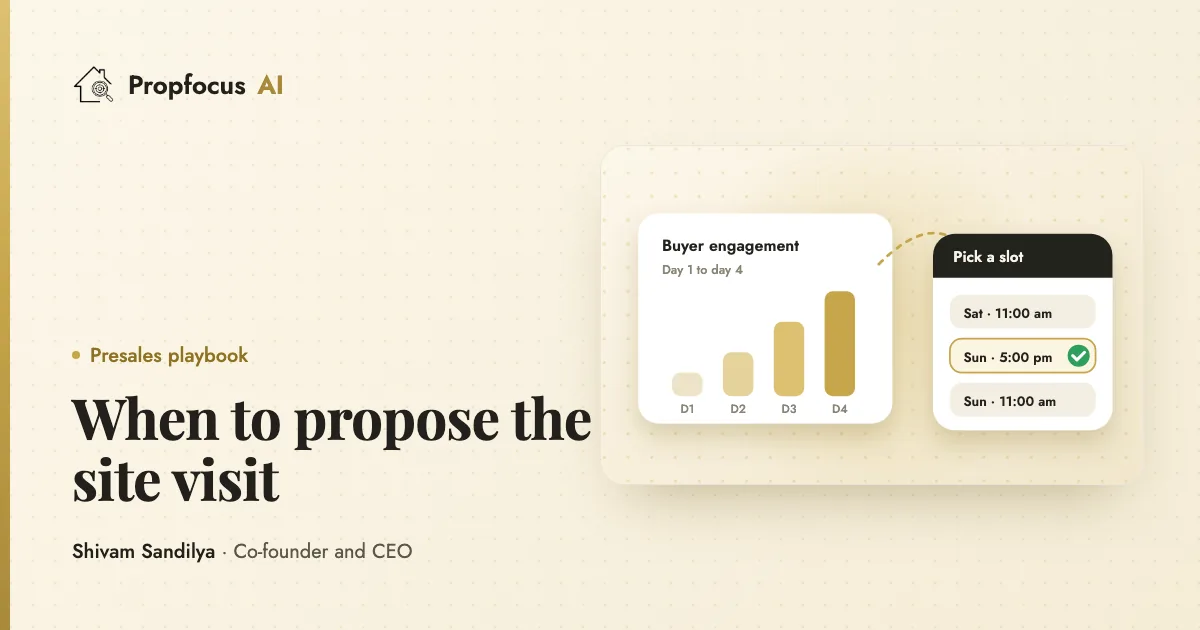
The short answer: propose the site visit when the buyer's own engagement says they are ready, not when the call script says it is time. A buyer who has opened the microsite for the project they asked about, come back to it, or asked about price or the payment plan is ready to hear about a visit. Before that, pushing for the visit costs you the lead. Timing beats pressure.
This post is for the presales head who writes the call script and owns the site visit target. Most presales teams are measured on visits booked, so the script asks for the visit on the first call. It feels efficient. In practice it books visits that never happen and quietly shuts down buyers who were still comparing projects.
Why does pushing for the site visit too early backfire?
On the first call, most buyers are still building a shortlist. They enquired on several projects in the same week, they have not shown the brochure to their family, and they do not yet know whether your price band fits. Asking them to give up a weekend morning at that point asks for a commitment they have not reached.
Three things tend to happen next.
- The buyer says yes to end the call. A polite "Saturday is fine" is the easiest way off the phone. That visit is a no-show waiting to happen, and the rep spends Friday evening chasing a confirmation that never comes.
- The buyer feels sold to and stops picking up. A second and third call about the same visit turns an interested buyer into a lead that rings with no response. Our guide to RNR (ringing, no response) leads covers how large that bucket becomes and how to bring those buyers back.
- The team's numbers look better than the walk-ins. Visits booked rise, visits done do not, and the weekend roster is planned around buyers who were never coming.
None of this is a script problem you can fix with better wording. It is a timing problem. The same invitation that fails on day one often works on day four, once the buyer has looked at the project properly.
What signals say a buyer is ready for a site visit?
Readiness shows up in what the buyer does, not in what they say on the first call. The signals that matter most are simple:
- They opened the microsite for the project they asked about. Not the brochure forwarded on a family group, the page itself.
- They came back to it. A second or third look, often late in the evening or on the weekend, usually means someone else at home is looking too.
- They asked a decision question. Price, payment plan, possession date, home loan, which tower gets the morning sun. People ask these when they are picturing living there.
- They replied on their own after going quiet. A buyer who restarts the conversation is telling you the timing has changed.
No single signal is a promise. Together they shift the odds sharply, and the case studies show by how much. In one portfolio of 10 projects across Bengaluru and Hyderabad, 16.6% of the buyers who engaged with their microsite walked in for a site visit, against 5.8% of buyers who showed no signal. That is the 2.9x gap. Engaged buyers were 37% of the buyers and produced 62% of the site visits. Two other developers saw the same pattern: engaged buyers converted 4.2x better across 5 projects in Bengaluru, and 2.4x better across 6 projects in Bengaluru.
The practical rule follows from that. Propose the visit to buyers who are showing these signals. Keep working the rest, but do not ask them for the weekend yet.
How soon after the signal should you propose the visit?
Quickly. Readiness does not last. In the 10-project portfolio, the median time from the buyer receiving their microsite link to the site visit was 2 days, and 77% of those visits happened inside a week. In the 5-project portfolio, half the attributed site visits happened within 2 days of the link going out.
That means the right moment to call is the morning after the buyer engages, not at the next slot in a weekly follow-up cycle. A good readiness call sounds different from a first call:
- Start from their enquiry. "You asked about the layouts. Did the 3 BHK work for you?"
- Answer the question they asked before you ask for anything. If they asked about the payment plan, lead with it.
- Offer specific choices, not an open question. "Saturday morning or Sunday evening?" gets a decision. "When are you free?" gets "I will let you know."
- Make the visit useful. Tell them what they will see, who will meet them and how long it takes.
What should the team do with buyers who are not ready yet?
Do not push them and do not drop them. A buyer who is not ready today is often ready next week, and the lead has already been paid for.
- Keep the conversation going on WhatsApp. Share what they asked for, answer questions when they come, and let the buyer set the pace. Our WhatsApp follow-up guide covers what to send and when.
- Put the price band out early. Buyers who cannot afford the project filter themselves out before anyone books a visit. We explain why in It's above our budget rarely means the price is the problem.
- Watch for the signal, then call. The moment a quiet buyer opens the page again, they move from the waiting list to the call list.
- Measure what matters. Lead to visit rate and cost per site visit tell you whether timing is working. Visits booked does not. Our guide on how to get more site visits from the leads you already have walks through both numbers.
Does better timing reduce site visit no-shows?
Yes, and it is the biggest lever most teams have. A visit the buyer chose after looking at the project is a very different commitment from a visit they agreed to on the phone to end a call. Better timing means fewer bookings that were never real, which is where many no-shows begin.
Timing does not replace the basics. Confirm the visit the day before with something useful, such as the location pin and the name of the person meeting them, and make rescheduling easy. Our post on reducing site visit no-shows covers what actually moves that number once the visit is booked, and what buyers do in the days after a site visit covers the follow-up.
How Propfocus AI times the visit
Propfocus AI is the AI presales platform for real estate developers. Its AI agents work every lead a developer has paid for, on WhatsApp and inside the developer's CRM, until it becomes a site visit. Timing the visit is built into how it works.
- Intent Alerts tells the rep when. It sees which buyers are engaging with the microsite for the project they asked about and tells the lead owner (the rep the lead is assigned to) who to call now, on WhatsApp. Each rep also gets a ranked call list every morning, so the first calls of the day go to the buyers who are ready.
- After hours, the agent proposes the slot. When a lead arrives after office hours, the project's AI assistant, for example "Skyline AI", answers on WhatsApp, proposes a site visit and offers slots the buyer can pick. The assistant always says it is an AI assistant. The RNR AI Agent restarts the conversation with leads that never picked up.
- The rep takes over. The lead owner confirms the visit and has the human conversation. Everything stays inside the developer's CRM, and the team keeps working the way it does today.
In the 10-project portfolio above, the microsite and Intent Alerts brought 63 site visits from leads the team had already written off as ringing with no response, with no new leads bought.
Frequently asked questions
When is the right time to propose a site visit to a property buyer?
When the buyer's engagement says they are ready: they have opened the microsite for the project they asked about, come back to it, or asked about price, payment plan or possession. In one 10-project portfolio, the median time from link to site visit was 2 days, so call soon after the signal.
How do you increase site visits in real estate without generating more leads?
Work every lead you already have, and propose the visit to the buyers who are engaging rather than to everyone on the same script. Buyers who engaged with their microsite were 2.4x to 4.2x more likely to visit in the case studies. Bring back leads that went quiet instead of writing them off.
Why do buyers book a site visit and then not show up?
Often because the visit was booked too early. A buyer who agrees on the first call to end the conversation has not yet committed. Proposing the visit after the buyer has looked at the project, and confirming it with useful details the day before, reduces no-shows.
Does the Propfocus AI assistant book visits without the sales team?
No. For leads that arrive after office hours, the project's AI assistant proposes a site visit on WhatsApp and offers slots the buyer can pick, and it always says it is an AI assistant. The lead owner then confirms the visit and takes over the conversation, and everything stays inside the developer's CRM.